
Context
This project was completed in 2016 within the Civil Engineering Department at Manipal University Jaipur, alongside a design internship at A-One Infraconsultants. It examined how rural drinking-water distribution systems are planned and designed when groundwater availability is constrained and communities need access to a dependable surface-water supply. The work followed the distribution chain from an elevated storage reservoir to village transfer chambers, public stand posts, and cattle water troughs. It brought together population forecasting, water-demand assessment, topographical survey information, hydraulic modelling, pipeline profiling, valve placement, thrust restraint, metering, and site observations.
The challenge
The design challenge was to distribute safe drinking water across rural settlements while maintaining adequate pressure, selecting suitable pipe diameters, accounting for terrain, and supporting reliable operation and maintenance. The network also needed practical provisions for air release, isolation, washout, water metering, and restraint at changes in pipeline direction. Because design decisions are interdependent, errors in demand, elevation, length, diameter, or node assignment can create negative pressure, excessive head loss, or unreliable service. The project therefore combined software simulation with manual checks and engineering calculations.
MADESAI's role
The project contributed to the design and drafting of village and cluster water-distribution networks during a civil-engineering internship. The work included forecasting population, calculating water demand, creating and checking EPANET hydraulic models, preparing pipeline longitudinal profiles, locating air and sluice valves, calculating bends, and designing thrust blocks. A second network was calculated manually to validate EPANET results, and Hazen-Williams and Darcy-Weisbach head-loss results were compared. Site visits connected the design work to constructed and operating infrastructure, including elevated storage reservoirs, clear-water reservoirs, pump houses, sump systems, valves, and monitoring systems.
Outputs
- Population forecasts and water-demand calculations for rural settlements.
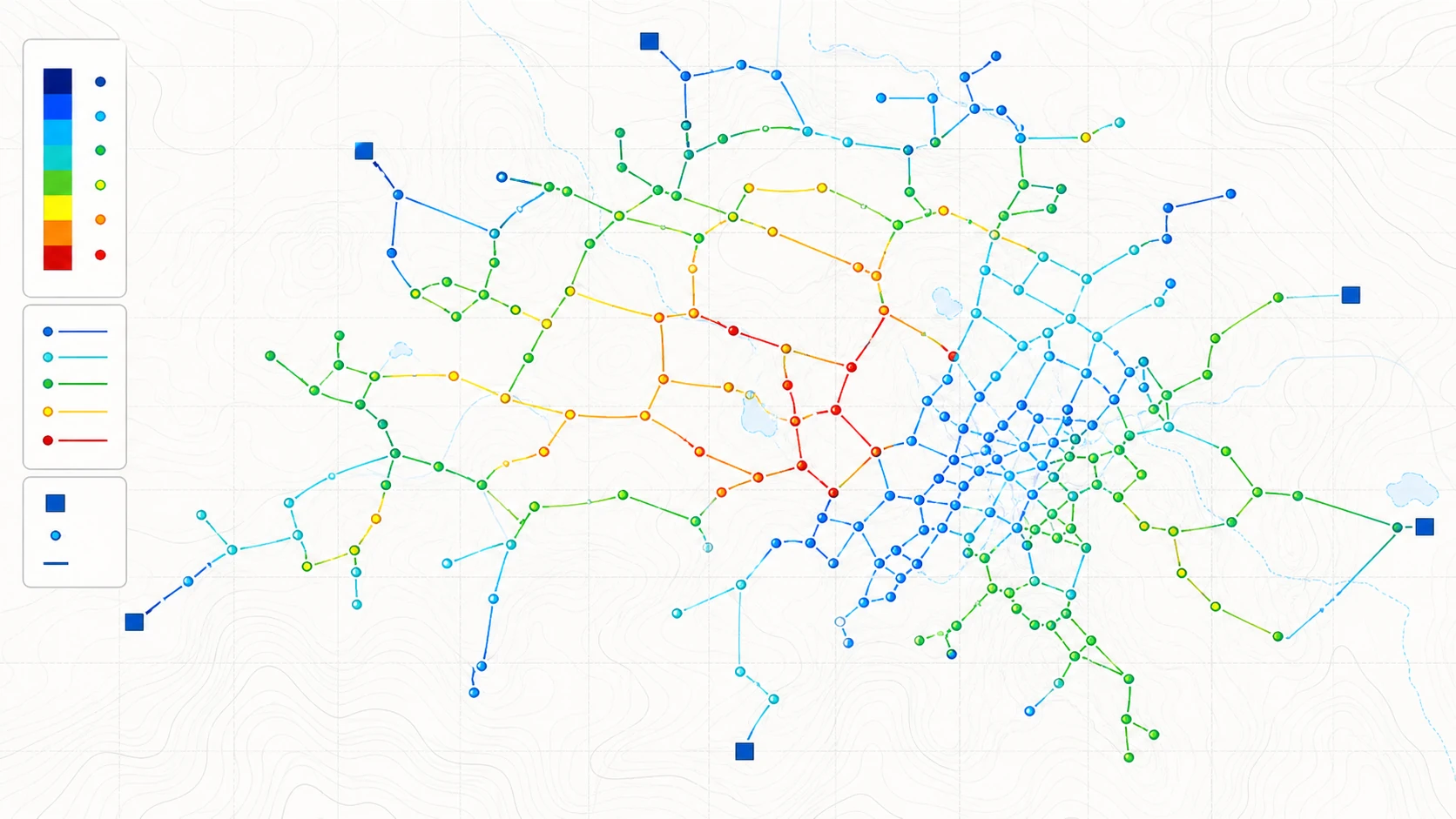
- Hydraulic network models developed in EPANET.
- Manual validation of simulated node pressures, flows, velocities, and head losses.
- Comparison of Hazen-Williams and Darcy-Weisbach head-loss methods.
- Longitudinal pipeline profiles incorporating ground levels, invert levels, hydraulic grade information, valves, and route geometry.
- Air-valve and sluice-valve placement logic for operation, isolation, and maintenance.
- Bend calculations and structural checks for reinforced-concrete thrust blocks.
- Review of water metering, storage reservoirs, pump houses, and monitoring arrangements.
Practical value
The project demonstrates an end-to-end approach to translating population, terrain, demand, and operational requirements into a checked water-distribution design. Its practical value lies in combining hydraulic simulation with manual validation and constructability-focused details so that rural supply networks can deliver adequate pressure and remain maintainable in service.
Responsible boundary
The work was completed as an undergraduate project and supervised internship contribution. It documents design learning, calculations, simulations, drafting, and site observations; it is not a current engineering certification, construction approval, as-built record, or operational performance guarantee. Final designs and site works remained under the responsibility of the appointed consultants, authorities, and contractors.