
Tags
Context
Following the foundational fire-safety research, the organisation needed to understand which market-available products and supplier systems might address practical mezzanine requirements across European applications. Options had to be considered for fire performance, structural loading, floor use, installation, documentation, availability, tested configuration, and country-specific acceptance.
The challenge
Product literature alone does not prove the performance of a complete mezzanine construction. Supplier systems are tested with defined materials, profiles, dimensions, fixings, layers, exposure directions, spans, and installation conditions. The challenge was to translate requirements into clear supplier inquiries, gather traceable evidence, identify promising options, and preserve the distinction between a candidate solution and a validated project-specific system.
MADESAI's role
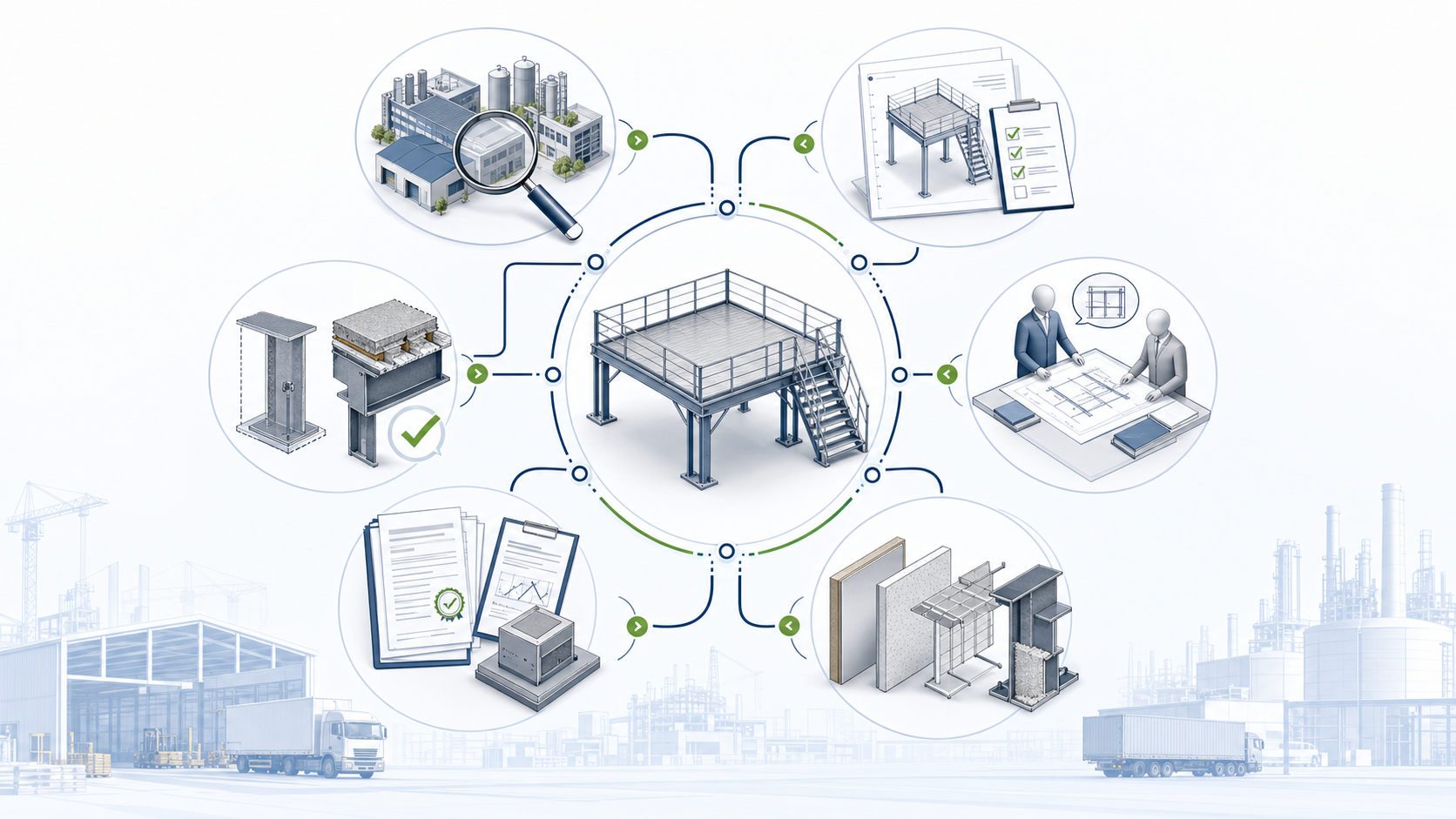
The work translated R&D findings into supplier-facing requirements, researched relevant manufacturers, coordinated technical discussions, collected supporting documentation, and organised candidate solutions for comparison and follow-up. Activities included supplier search and outreach, technical briefing, meeting coordination, evidence collection, system comparison, applicability review, collaboration presentations, and a separate reaction-to-fire test inquiry for corrugated decking plate.
Outputs
- Supplier landscape and outreach structure
- Supplier-facing fire-safety proposal request
- Technical meetings and documented correspondence
- Collected product classifications and performance documentation
- Candidate floor, ceiling, board, cladding, and protection options
- Supplier collaboration presentation
- Structured evidence folders and applicability review
- Corrugated-decking reaction-to-fire test inquiry
Practical value
The project connected high-level fire-safety research with real manufacturers, products, and system evidence. It provided a more structured basis for deciding which options merited deeper engineering, testing, commercial discussion, or rejection, while identifying evidence and applicability constraints early.
Responsible boundary
This was technical market research, supplier coordination, requirements translation, and preliminary evidence screening. It did not certify a supplier system, approve a construction for regulatory use, complete fire testing, provide authority acceptance, or prove that a selected option achieved a required classification in a live project.