
Tags
Context
A European mezzanine manufacturer needed a clearer technical foundation for discussing fire safety across custom steel mezzanine applications. The portfolio served storage, office, retail, public-access, and industrial environments, each with different fire loads, occupancy conditions, layouts, materials, and protection needs.
The challenge
Fire safety could not be reduced to one generic product claim. Appropriate measures depend on use, configuration, materials, the surrounding building, local requirements, and evidence for the complete tested construction. The challenge was to organise this broad subject into a usable decision foundation without implying that research, individual material classifications, or supplier literature proved project-specific compliance.
MADESAI's role
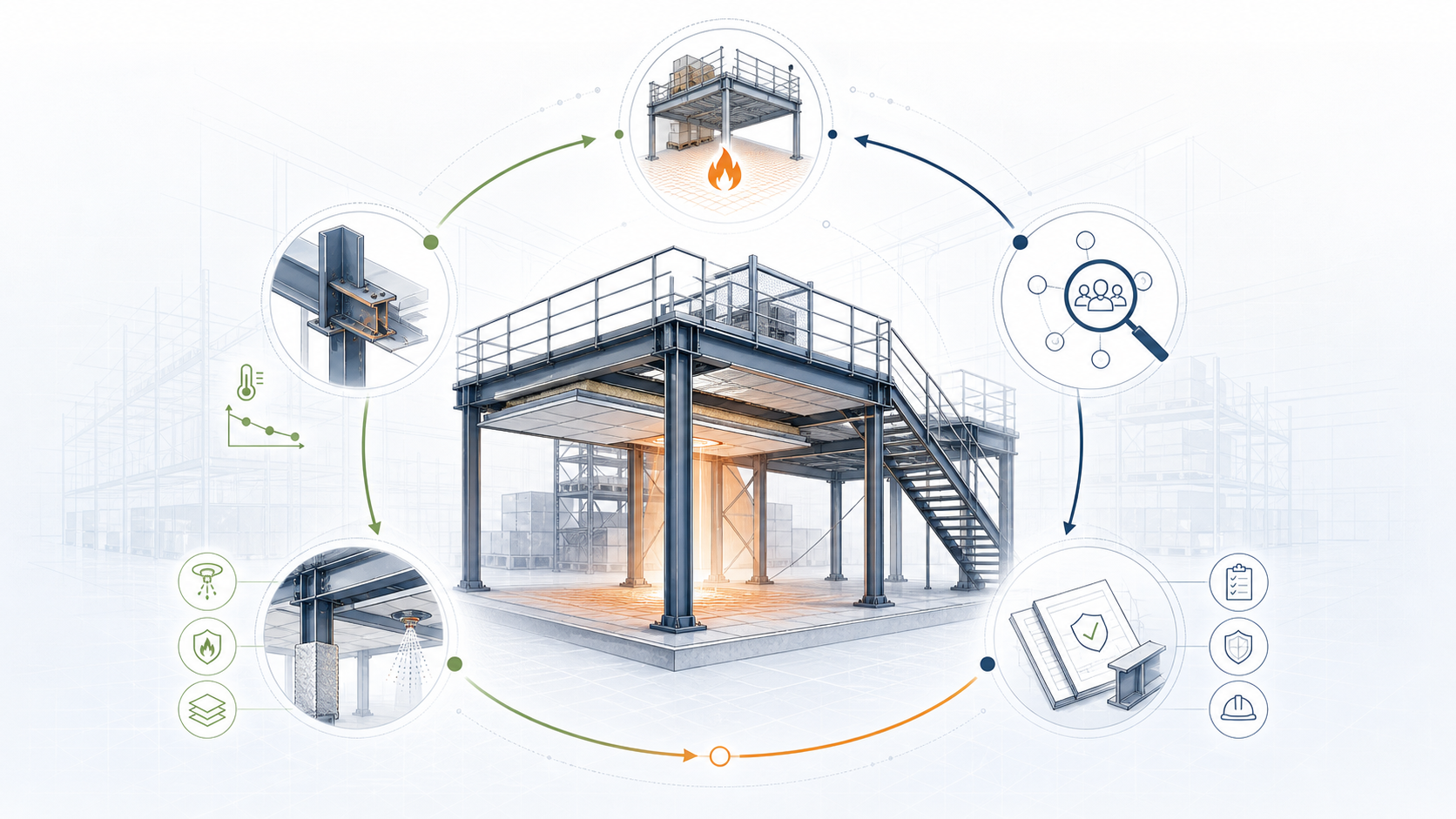
The work investigated how fire-safety engineering principles could be applied to a mezzanine portfolio and translated into structured research, scenario analysis, stakeholder guidance, solution priorities, and internal learning material. Key activities included researching fire development and structural behaviour; mapping mezzanine components; developing scenarios for storage, office, retail, public-access, and industrial applications; assessing stakeholder needs; comparing active and passive protection measures; and converting the findings into responsible technical communication guidance.
Outputs
- Foundational fire-safety research report
- Mezzanine fire-scenario and mitigation tables
- Active and passive protection comparison
- Stakeholder power-interest analysis
- Fire-safety product-passport structure
- Internal technical learning material
- Prioritised future research and development topics
Practical value
The project created a shared technical foundation for discussing mezzanine fire safety across R&D, management, and commercial teams. It clarified why strategies must be tailored to application and configuration, and established a more responsible communication standard based on verified evidence and clearly stated limitations.
Responsible boundary
This work provided foundational research, scenario analysis, stakeholder mapping, solution screening, internal guidance, and an R&D roadmap. It was not project-specific fire-engineering design, authority approval, legal interpretation, certification, or proof that a complete mezzanine system achieved a stated classification.