
Tags
Context
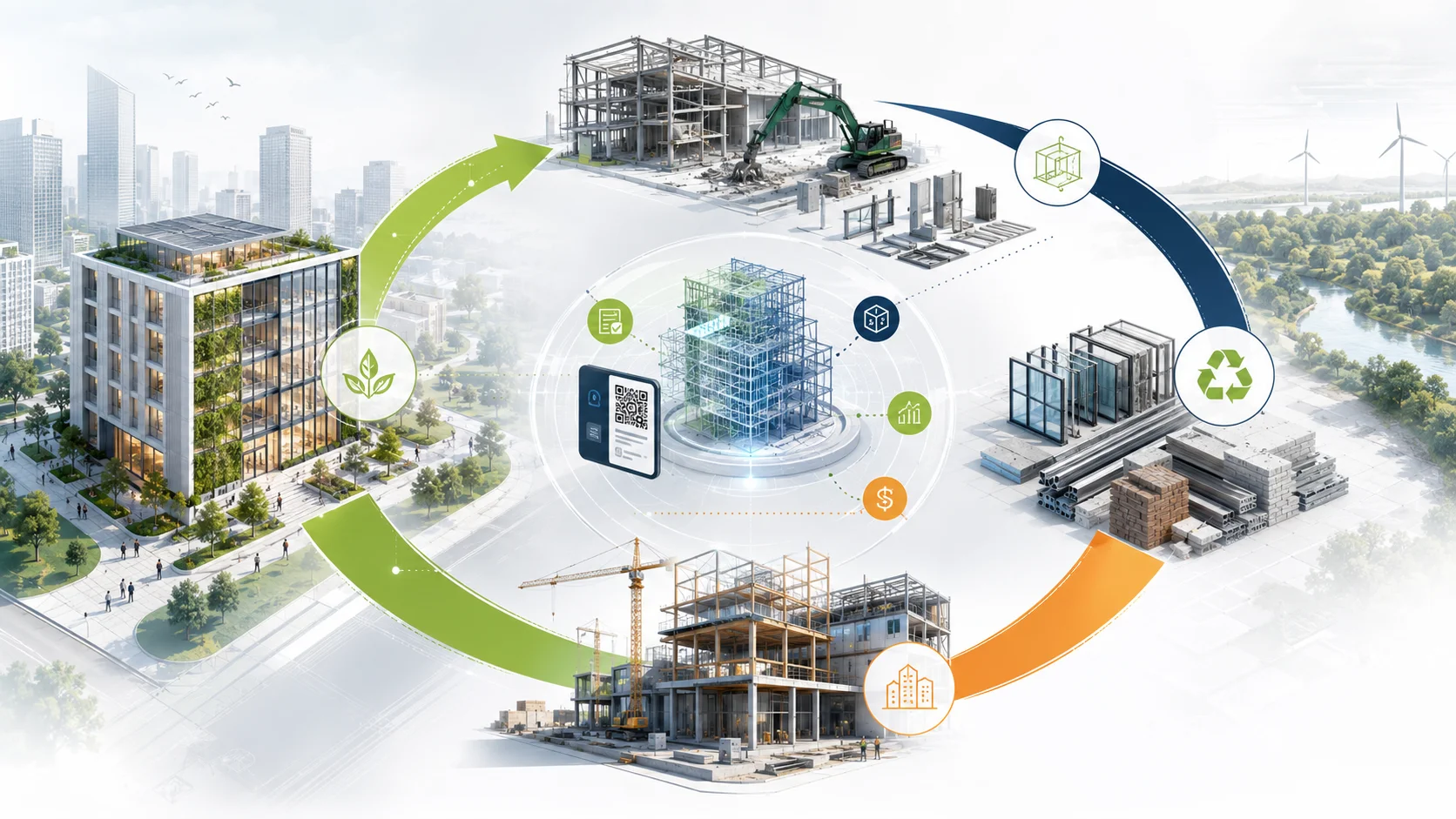
This research explored how to value, document, recover, and trade building assets within a circular construction ecosystem. The work responded to a key challenge in the built environment: valuable building components are often lost through demolition because asset information, reuse potential, quality status, market demand, and recovery planning are not structured early enough. The research developed a circular procurement and asset valuation framework for second-use building components. It connected circular procurement, BIM-based asset information, deconstruction planning, site and inventory inspection, disassembly potential, lifecycle cost and environmental assessment, residual value, and online resource trading.
The challenge
The main challenge was that construction assets are usually treated as waste at end-of-life, even when components may still hold economic, functional, or environmental value. The sector lacked a structured way to assess what should be reused, recovered, resold, refurbished, or discarded. The problem was not only technical; it was also an information-management and decision-making problem. The work, therefore, focused on answering the following: 1. What information is needed to evaluate a building component for second use? 2. How should that information move between stakeholders? 3. What kind of procurement/trading process can support circular reuse?
MADESAI's role
We structured the circular procurement and asset valuation logic for building components intended for second use. The work focused on translating a broad circular construction problem into a practical decision-support framework covering asset information, reuse potential, quality assessment, deconstruction planning, resource recovery, and material trading. The role was to connect circular economy principles with built-environment workflows by identifying what information is required, which stakeholders use it, how asset value can be assessed, and how BIM-enabled information structures can support reuse-oriented procurement decisions. The contribution was advisory and framework-based: problem structuring, research synthesis, process mapping, information requirement definition, circular procurement indicator mapping, and development of decision logic for resource recovery and second-use asset trading.
Outputs
- A circular procurement framework for valuing building assets for second use.
- A structured logic for site and inventory inspection.
- An exit scenario and resource recovery planning approach.
- A partial deconstruction planning structure.
- A concept for the online trading of recovered building components.
- A breakdown of the information requirements for asset passports.
- A mapping of circular procurement indicators relevant to sellers, buyers, process actors, and marketplace platforms.
- BIM-based logic for using asset information, 4D planning, 5D cost data, WBS, CBS, and OBS structures.
- A QR-code-based concept for handing over product information during resource trading.
Practical value
The practical value lies in helping clients identify recoverable value before demolition happens. Instead of treating a building as waste, the framework helps break it into assets, information requirements, recovery options, and possible trading routes.
Responsible boundary
The research covered framework development, process mapping, information requirement definition, circular procurement indicator mapping, and decision-support logic. It did not include live project implementation, certified asset valuation, structural reuse approval, software development, marketplace operation, regulatory approval, or commercial deployment.