
Tags
Context
A technical manufacturing context required a clearer documentation structure for sustainability-reporting support and double materiality work.
The challenge
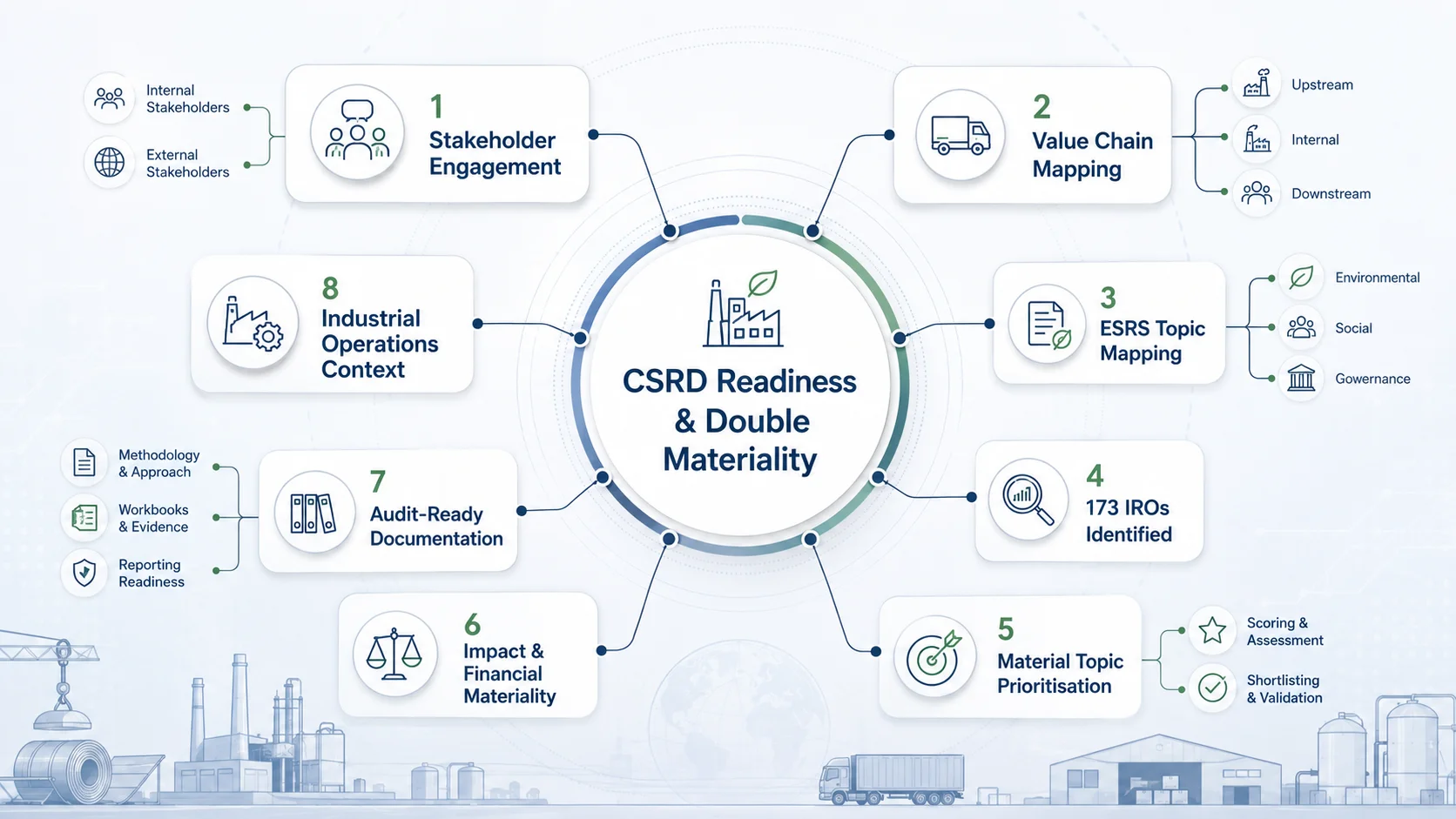
The client needed to move from general sustainability awareness to a structured CSRD readiness process. The key challenge was translating the CSRD and ESRS requirements into a practical operating model that could be understood and used by management, operational departments, sustainability partners, and future reporting stakeholders. The work required more than just regulatory explanation. It required building the internal logic for a double materiality assessment: defining the organizational scope, clarifying ownership, mapping the value chain, identifying affected and influencing stakeholders, developing a long list of sustainability matters, linking impacts, risks, and opportunities to ESRS topics, and preparing internal prioritization logic. The client also needed a way to engage different stakeholder groups through desktop research, focus groups, interviews, open surveys, and internal prioritization exercises without overwhelming the organization.
MADESAI's role
MADESAI supported the CSRD readiness and double materiality assessment workstream by converting CSRD and ESRS requirements into practical methodology, documentation, and decision-support tools. The role included ESG research, CSRD/ESRS interpretation support, value-chain structuring, stakeholder mapping, engagement strategy development, material topic long-list preparation, impact-risk-opportunity mapping, internal prioritisation logic, and preparation of internal communication material. MADESAI connected sustainability regulation with the organisation’s actual operating model, including production, engineering, logistics, purchasing, sales, installation, governance, workforce, suppliers, customers, and downstream activities. Key activities 1. Structured the double materiality assessment methodology around preparation, identification, assessment, and prioritization. 2. Defined the DMA purpose, scope, ownership, time horizons, operating boundaries, and reporting-readiness logic. 3. Mapped the value chain across upstream, internal, and downstream activities, including raw materials, steel, wood, chemicals, energy, operational inputs, sales, engineering, purchasing, production, logistics, installation, and after-sales service. Identified internal and external stakeholder groups relevant to both impact and financial materiality. 4. Classified stakeholders by value-chain position, internal/external relationship, primary/secondary relevance, and potential engagement approach. 5. Prepared stakeholder engagement logic using interviews, focus groups, open surveys, internal meetings, workshops, and desktop research. 6. Supported long-list development using ESRS topic lists, workshop results, peer and sector research, sustainability benchmark sources, and industrial materiality references. 7. Mapped sustainability topics and IROs to ESRS themes and subtopics to support future reporting traceability. 8. Prepared internal material topic prioritization logic for moving from a broad ESG topic universe toward a focused set of topics for further validation. 9. Prepared CSRD handouts to explain CSRD, double materiality, reporting relevance, stakeholder contribution, and the organization's DMA approach. 10. Structured documentation to support future gap analysis, management discussion, audit-readiness, and reporting preparation.
Outputs
- CSRD / DMA methodology paper
- Double materiality assessment process structure
- CSRD readiness roadmap
- Reporting scope and organisational boundary logic
- Value-chain map
- Written value-chain description
- Internal stakeholder map
- External stakeholder map
- Stakeholder engagement strategy
- Stakeholder prioritisation logic
- Material topic long list
- Impact, risk, and opportunity mapping structure
- ESRS topic and subtopic mapping
- Internal material topic prioritisation workbook
- Stakeholder analysis workbook
- Internal CSRD handouts and presentation material
- Engagement preparation structure for desktop research, focus groups, interviews, and open surveys
- Audit-readiness and documentation logic for future CSRD reporting preparation
Practical value
The project helped the organization convert CSRD from an abstract regulatory requirement into a practical internal workstream. It clarified what needed to be assessed, which entities and operations were in scope, where sustainability impacts and risks could occur across the value chain, which stakeholders needed to be engaged, and how material topics could be prioritised. The work created a usable foundation for future CSRD reporting by connecting regulatory requirements with business operations, stakeholder input, ESG data needs, and management decision-making. It reduced ambiguity for leadership and operational contributors by creating a structured basis for stakeholder engagement, gap analysis, reporting preparation, and future assurance discussions.
Responsible boundary
MADESAI was responsible for methodology structuring, ESG research support, value-chain mapping, stakeholder mapping, engagement strategy development, material topic long-list preparation, prioritization logic, internal communication material, and reporting-readiness documentation. MADESAI was not responsible for: 1. Final legal interpretation 2. Statutory CSRD sign-off 3. External assurance 4. Auditor conclusions 5. Final sustainability statement publication 6. Final ESRS datapoint submission 7. Certification of the organisation’s sustainability performance